
How effective is Yudhishthira's policy of peaceful resolution of disputes in international politics?

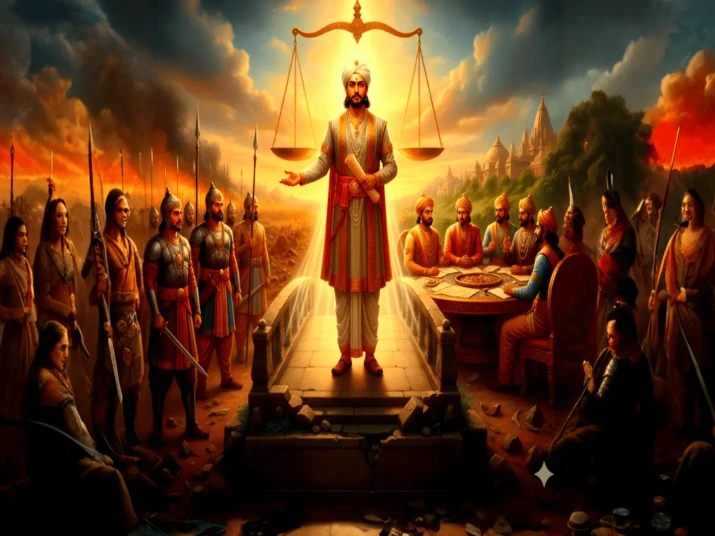
Table of Contents
- How effective is Yudhishthira's policy of peaceful resolution in resolving the dispute with the Kauravas in international politics?
- Why is Yudhishthira's just diplomacy before the war in the Mahabharata a unique example?
- The reality and moral acceptability of the statesman's dual policy of favoring peace and war when necessary?
- How is Yudhishthira's judicial policy as a king comparable to that of today's democratic courts?
- How realistic is it to lead a family today in maintaining balance among the five brothers?
- How can Yudhishthira's patience and tolerance in times of crisis be applied to today's socio-political crises?
- Which qualities of Yudhishthira are most valuable from an administrative perspective in modern state management?
- What does Yudhishthira's being the only survivor in his ascension to heaven signify as a spiritual symbol?
- Can Yudhishthira's overly trusting nature cause problems in family or career?
- How applicable are Yudhishthira's qualities as an ideal statesman in today's society?
How effective is Yudhishthira's policy of peaceful resolution in resolving the dispute with the Kauravas in international politics?
Yudhishthira of the Mahabharata always followed the policy of peaceful resolution in resolving disputes with the Kauravas. He was in favour of solving problems through justice, diplomacy and dialogue, not through a show of power or war. This view of Yudhishthira basically proves that leadership is not just a show of strength, but a combination of patience, fairness and diplomatic skills. Despite the injustice, deceit and arrogance of the Kauravas, he always first sought peace and a just compromise, which was an attempt to avoid conflict with them.
Yudhishthira's policy of peaceful resolution is very relevant in today's international politics. When states are faced with conflicts, border disputes or economic competition. It is very important to give importance to conciliatory diplomacy, negotiation and international law. The peaceful resolution process can play an effective role in avoiding conflict and maintaining stability.
However, in reality, just like the Kauravas in the Mahabharata, there are selfish and powerful parties. Similarly, in the international arena, some states ignore diplomacy and dialogue and use force to promote their interests. Therefore, a peaceful policy does not always automatically yield results, but it lays the foundation for long-term stability, moral leadership and trust.
Therefore, Yudhishthira's policy teaches us that conflict can be dealt with through patience, fairness and dialogue. And it is also effective in current international politics, if a balanced combination of force and justice can be created. Establishing peace is not easy, but it is always the best and long-term solution.
Why is Yudhishthira's just diplomacy before the war in the Mahabharata a unique example?
In the Mahabharata, Yudhishthira can be identified not only as a brave war leader but also as a just and prudent diplomat. His diplomatic role before the war was very important, as he tried his best to establish peace and control the conflict.
First, the attempt to establish peace. The Pandavas were only demanding rights, but Yudhishthira used strategic diplomacy to avoid war. As advised by his far-sighted advisor Vidura, he negotiated with the Kauravas. Often, he adopted the path of peace efforts, maintaining simple and just presentations and complete conservatism. This shows that he did not just act out of arrogance or a show of strength, but took steps with a combination of strategy and justice.
Second, moral and just diplomacy. Yudhishthira always kept an eye on justice. Not only military advantage, but his diplomatic decisions were also based on justice and religion. He tried all the alternatives before starting the war, so that the losses between the Pandavas and the Kurus could be reduced.
Third, foresight and reactive strategy. Yudhishthira knew that solutions were possible not only through force and weapons, but also through strategy, negotiation skills, and taking timely steps. His diplomatic role was not only to prepare for war, but also to achieve long-term stability.
In the final decision before the war, Yudhishthira played a true diplomatic role. He did not resort to force, but to peace efforts combined with justice, honesty, and foresight. This proves that when strategy and morality are combined, not only war, but also social and political stability can be established.
The reality and moral acceptability of the statesman's dual policy of favoring peace and war when necessary?
The most complex aspect in evaluating the leadership of a statesman is to be in favor of peace and to maintain readiness for war when necessary. A kind of dual tendency, which is important from both practical and moral aspects. The leadership of Yudhishthira in the Mahabharata is considered an ideal example from this perspective. He was always committed to justice and peace. But when injustice, fraud, or when the security of the state is threatened. Then he did not see war as an irrational or dishonest act.
This dual tendency is very realistic in today's modern state management. In world politics, states maintain peace through diplomacy, dialogue, and international agreements on the one hand. However, when crises arise, such as border disputes, terrorism, economic pressure, or the spread of international influence. Then, adopting a limited military system and defense policy becomes mandatory. A skilled statesman maintains a balance between peace and war not only through a show of force but also through a combination of patience, diplomacy, and moral decisions.
The main reason why this dual tendency is acceptable is that it creates a basis for long-term stability and trust. If the state leader only proceeds on the path of war, it can create indefinite conflict, humanitarian losses, and a lack of international trust. On the other hand, showing undue flexibility only on the path of peace can make the situation more complicated due to the provocations or threats of the opponent. Therefore, it is necessary to consider both peace and war strategically.
From Yudhishthira's perspective, it can be seen that morality, honesty, and patience are the foundations on which the dual tendency can be effectively managed. He never encouraged war for the sake of violence. Rather, he saw it only as a necessary measure to prevent injustice and insecurity. The application of this principle is also very important in modern political and administrative systems. It not only ensures the security of the state but also provides an opportunity to establish public trust, international cooperation, and moral leadership.
In short, the two combined qualities of maintaining peace and being prepared for war if necessary are practical and acceptable for a statesman. This reflects the combination of strategic intelligence, morality, and foresight in the modern political situation. If a leader has patience, fairness, and integrity, this dual tendency is not only effective. Rather, it is capable of ensuring stability and security for the state and society in the long run.
How is Yudhishthira's judicial policy as a king comparable to that of today's democratic courts?
King Yudhishthira's judicial policy was based on justice, honesty, and impartiality. He did not submit to personal interests or influence and always gave priority to law and justice. Yudhishthira's fairness and equal approach to all are directly comparable to the principles of independent and impartial courts in today's democratic states.
In a democratic society, courts make decisions according to the law and do not keep in mind any political pressure, social position, or personal influence. Just as Yudhishthira never ignored a powerful or influential person in a trial. The court also tries to avoid bias in the trial process. Moreover, according to Yudhishthira's policy, justice was not limited to punishment or reward alone. It was also a means of moral education and establishing stability in society. Contemporary courts also try to maintain social peace and order through fair verdicts.
Both Yudhishthira's judicial principles and the principles of modern democratic courts emphasize fairness, impartiality, and the rule of law as the highest standards. King Yudhishthira's sense of justice still teaches us today that even in leadership or power, it is most important to administer justice based on truth and justice.
How realistic is it to lead a family today in maintaining balance among the five brothers?
In Yudhishthira's case, the responsibility of maintaining balance among the five brothers was not only to distribute power in the kingdom, but also to maintain justice and respect in the relationship. He never gave priority to any brother, but tried to maintain fairness and equal opportunities among all. This was the ultimate expression of moral leadership, where personal relationships and a sense of responsibility played an important role together.
Maintaining such a balance in today's family and modern society is somewhat challenging, but not completely impossible. In a modern family, the distribution of financial, educational, or social opportunities, the attitude of the guardian, and the individual personality of the children, these factors play a big role in maintaining balance. If the guardian or head of the family in leadership maintains a just, sensitive, and equal opportunity attitude like Yudhishthira. Then it is possible to deepen the relationship by reducing blame and competition between siblings.
However, there are also limitations to reality. In a modern family, the individual needs, preferences, and competitive tendencies of each child always make it difficult to maintain a fair balance. In addition, external social and economic pressures can also hinder the ability to maintain balance in the family.
However, Yudhishthira's principle of just leadership and maintaining balance is an ideal example for modern families, which inspires. Although implementation is not always easy, it is quite possible to maintain balance between siblings in modern families through a just attitude, sensitive decisions, and active communication.
How can Yudhishthira's patience and tolerance in times of crisis be applied to today's socio-political crises?
Yudhishthira's patience and tolerance a key examples in the Mahabharata. When he faced the injustice, deceit, and challenges of the Kauravas, he never made decisions based on strong revenge or emotion. Rather, he dealt with the situation through analysis, fairness, and patience. This attitude of his proves that a calm mind, a tolerant attitude, and far-sighted thinking are the most effective tools in times of crisis.
Yudhishthira's principles can be applied in various ways in today's social and political crises. For example, if leaders assess the situation with patience and tolerance during political conflicts or social tensions, then it is possible to avoid unwanted conflicts and violence. In addition, dialogue, compromise, and fair decision-making in dealing with social movements or public protests are direct applications of Yudhishthira's principles. It is not just a temporary solution to a problem, but also creates an environment of stability and trust in society in the long run.
Moreover, a patient attitude like Yudhishthira is also important in personal or organizational leadership. If leaders make decisions based on information and justice instead of emotions, then the risk of making wrong decisions in critical situations is reduced. In addition, tolerance creates opportunities for compromise by bringing different parties together. This helps bring stability to modern political and social processes.
Yudhishthira's patience and tolerance are also relevant in today's era. It teaches us that in dealing with crises, it is not strength or force, but a calm mind, fairness, and far-sighted strategy that are the path to long-term solutions.
Which qualities of Yudhishthira are most valuable from an administrative perspective in modern state management?
Yudhishthira's qualities are very relevant and exemplary from an administrative perspective in modern state management. Some of the key characteristics of his leadership and personality are especially valuable in today's administrative management:
1. Fairness and impartiality:
Yudhishthira always made decisions by prioritizing justice and law. He did not allow personal interests, relationships, or political pressure to influence the judicial process. In modern administration, such fairness builds the foundation of administrative discipline, accountability, and public trust.
2. Patience and tolerance:
Yudhishthira's patience and tolerance during times of crisis and conflict are important in administrative leadership. In modern states, a calm mind and a tolerant approach to dealing with political, economic, or social crises maintain the morale of the workers and create opportunities for effective solutions.
3. Foresight and strategic intelligence:
Yudhishthira understood the situation and adopted strategies, although sometimes it was risky. In modern administration, foresight and information-based strategic planning are essential for policy formulation and ensuring revenue, security, or social welfare.
4. Ethical leadership and integrity:
Yudhishthira's integrity and ethics can be used as an example in administrative culture. Such leadership increases credibility in today's government or private organizations and reduces corruption and unethical behavior.
5. Balanced decision-making:
He maintained balance in the family, cabinet, or battlefield. Similarly, in modern administration, adopting balanced policies between different interests, disagreements, and the needs of the people is very important.
Yudhishthira's fairness, patience, ethics, foresight, and balanced leadership are considered the most valuable qualities in modern state management from an administrative point of view. Such qualities not only ensure effective administration but also establish the trust and respect of the people towards the state and society.
What does Yudhishthira's being the only survivor in his ascension to heaven signify as a spiritual symbol?
Yudhishthira's being the only survivor in his ascension to heaven is one of the spiritual symbols of the Mahabharata. It is not only a reward for his morality, but also the ultimate recognition of his meditation, honesty, and inherent righteousness. Yudhishthira never did anything selfish or dishonest in his life. He always took the difficult decisions of running the kingdom, family responsibilities, and wars on the basis of justice, honesty, and morality.
From a spiritual perspective, his being the only survivor teaches us that the path of justice and truth is eternal and deserves the ultimate reward. Despite all the forces, temptations, or deceptions in the world that tempt people to go astray, Yudhishthira keeps his ideals intact. This shows that spiritual progress or liberation is not only the result of actions. A conscious life combined with character, honesty, and attitude is the path to supreme success.
It also reflects the greatness of responsibility and sacrifice. In Yudhishthira's life, personal interests are always temporary, while the value of justice and truth is eternal. His only surviving ascension to heaven shows that living a life of integrity and morality can lead to insight, peace of mind, and spiritual excellence.
Yudhishthira's only surviving spiritual symbol teaches us that steadfastness in the path of truth, justice, patience, and morality is the sign of ultimate liberation and ultimate peace. This is not just history, but an eternal lesson in spiritual life.
Can Yudhishthira's overly trusting nature cause problems in family or career?
Yudhishthira's overly trusting nature is considered one of the most important character weaknesses in the Mahabharata. Although his fairness and truthfulness are admirable, his unlimited trust in others repeatedly puts him in danger. For example, sitting in a gambling den at the instigation of Duryodhana, not being able to understand the deceit of Sakuni, etc. These experiences actually highlight a deep lesson in human life that overtrust can sometimes be dangerous.
Yudhishthira is seen as a symbol of justice, honesty, and trust in the Mahabharata. However, his overly trusting nature, due to which he often did not understand the deceit or ill intentions of people, caused problems not only in Kurukshetra but also in family and royal life. In modern society, such a nature can also be risky for individuals and families, workplaces, and leadership.
First, problems in family life. An overly trusting person can easily be misled by the words of others. Yudhishthira easily believed Duryodhana's deception, the exile of the Pandavas, and gambling, which created crisis and unrest in the family. In today's society, such a trusting nature can often lead to wrong decisions, unnecessary conflicts, and confusion within the family.
Second, risks in a career. If someone is overly trusting in the work environment, they may fall victim to the tricks, selfishness, or deceit of a colleague or manager. This increases the chances of project failure, organizational damage, and loss of personal honor.
Third, the impact on leadership and decision-making. Excessive trust often reduces caution and reduces strategic discretion. Just as Yudhishthira was easily influenced by the words of his sons and the royal family, in modern leadership, excessive trust can weaken decision-making ability.
Although Yudhishthira's overly trusting nature is part of his moral qualities, it has become a cause of problems in his family and career life. While honesty and trustworthiness are important in modern life, it is essential to combine them with compromise, restraint, and prudence. Otherwise, disaster can come to personal and social life.
How applicable are Yudhishthira's qualities as an ideal statesman in today's society?
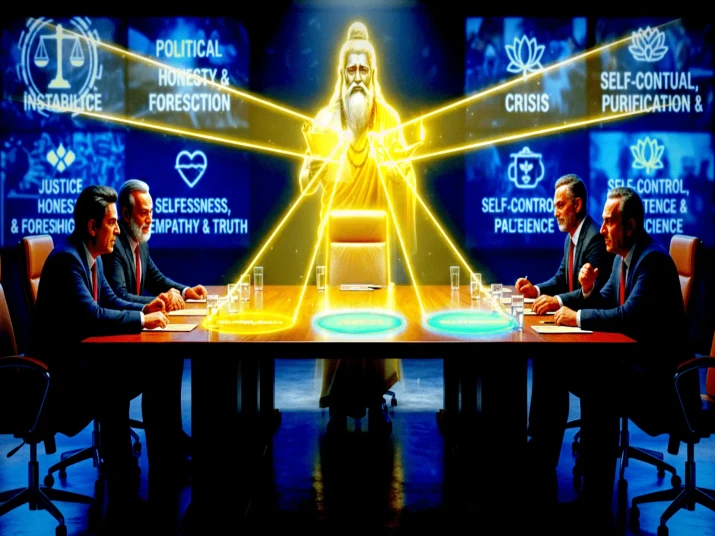
In the Mahabharata, Yudhishthira is portrayed as a just, honest and prudent leader. Some of Yudhishthira's qualities as an ideal statesman in today's society are very relevant and applicable.
First, fairness. Yudhishthira always followed the path of justice and truth. Fairness is essential for a modern statesman, as it not only ensures political stability but also instills the trust and confidence of the people. A just leader can establish a culture of equality in society.
Second, foresight and strategic judgment. Yudhishthira not only saw the current situation but also considered the future implications. Foresight is also essential in modern leadership, so that solutions can be taken by considering the long-term impact of policies or decisions.
Third, moral stability and integrity. Yudhishthira was a believer and cautious; he never compromised on selfishness or temptation. For a modern leader, honesty and moral stability are essential in gaining public trust and preventing corruption.
Fourth, calmness and patience. Yudhishthira remained calm and composed even in difficult situations. In today's society, such a calm attitude is effective for solutions and dialogue amidst political and social pressures.
Fifth, a sense of responsibility and a combination of family and social values. Yudhishthira showed that true leadership is established when a leader works not only for power but also for the welfare of society and the people.
As an ideal statesman in today's society, Yudhishthira's fairness, foresight, honesty, calmness and sense of responsibility are very applicable. These qualities help to make leadership in modern politics permanent, just and socially beneficial.
Tags
For Add Review. You Need To Login First Login Page
Related News




-
LATEST
-
POPULAR

What is marriage according to Sanatan Dharma and why is marriage called a bond of birth and rebirth?

The Sydney attack is also the result of the same petro-dollar, Pakistan and Deep State radical narratives.

Comments
No comments yet